.png)
Let's talk about optimizing for LLMs
Until now, if a brand wanted online visibility, it had to play the SEO game: include keywords in strategic positions throughout the text, structure the page well, write clear titles, add links and meta-descriptions…
For years, that's been the norm, and it's shaped how companies create content. Everything was designed to please Google and earn its blessing in the form of visits. But… what happens if people are no longer searching on Google as much? What impact is the arrival and spread of generative AI having? Let's talk about LLMO (large language model optimization), i.e., optimizing for AI models.
A new landscape: users no longer search only on Google
For about a year now, something has been shifting: more and more people are typing their questions straight into tools like ChatGPT, Gemini or Copilot. These tools don't return a list of links to relevant web pages, like Google would. They give you an answer. Clear. Direct. No clicks. Which means that, in many cases, you don't need to visit a website to get the information. That changes the rules of the game: if users no longer reach your site through Google, how will they?
Look at what the data from SurferSEO tells us:
- Traffic to generative AI tools grew by 1200% between July 2022 and February 2024.
- OpenAI has surpassed 800 million weekly active users.
- Some studies predict organic traffic from Google will fall by up to 50% over the next few years.
And while Google is still king, habits are changing. More and more users are turning to alternative engines or directly to AI tools to answer their everyday questions.
Faced with this new paradigm, how can companies adapt and keep their visibility? The answer lies in LLMO, optimization for large language models.
How do AI models choose content?
Where does ChatGPT get its information from? And how does it decide what to show? For now, there's no clear answer from OpenAI, Microsoft or Google with explicit instructions on what to do so your site appears among AI-generated responses. But there are some clues.
Language models are trained on huge volumes of public data available on the web — pages, books, Wikipedia, forums or articles. When they have internet access, as happens with ChatGPT's browsing mode or Copilot/Bing, they consult relevant sources, synthesize the information and generate an answer. Sometimes they explicitly cite the sources, although in many cases they simply produce content based on what they've previously read. Generally, they seem to prioritize trustworthy, well-structured, clear, up-to-date and useful sources. And in many cases, content that's clear, direct and in question-and-answer format is more likely to be used.
In other words, many of the criteria that favored good SEO ranking are still valuable for ranking inside AI tools. What's clear is that, if we want to appear in their answers, we need to think differently. We're no longer writing only for a search engine — we're also writing for a conversational model.
Going shopping in ChatGPT
A crystal-clear example of this trend is what OpenAI has rolled out in its shopping feature inside ChatGPT. You can now ask the bot what the "best boxing shoes" are and the chat will show you products directly with links to buy them.
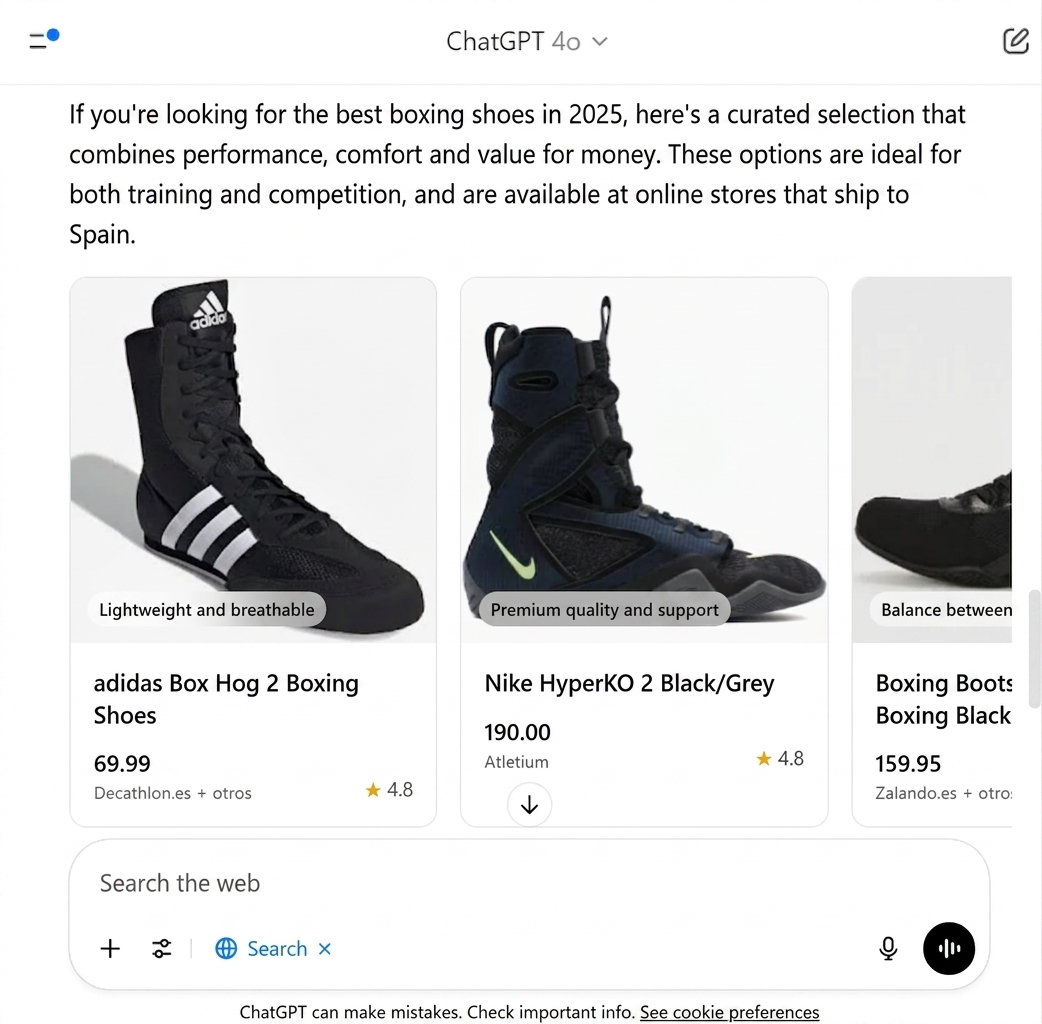
According to OpenAI, these are the criteria it uses to display products:
- User intent: it interprets the question correctly to understand what you're looking for.
- Product data: such as price, ratings, ease of use, etc.
- Model knowledge: it uses its prior knowledge to suggest relevant options.
- Safety: it applies filters to avoid showing sensitive or unreliable content.
This anticipates something key: purchase decisions are no longer made on Google. They're made inside the chat itself. And that puts the visibility of many e-commerce sites, blogs and specialized media at stake.
A survival guide for brands in the AI era
The good news: we're not starting from scratch. Many of the things that worked in SEO still apply, with some nuances. Here are a few recommendations:
- Write "question-and-answer" content: think about how your audience would actually phrase their doubts. Use FAQ formats, question-style headlines, and answer in short paragraphs.
- Give clear, complete, to-the-point answers. No padding. AI tools reward clarity.
- Publish on outlets the AI considers trustworthy: well-structured sites with topical authority, internal linking and solid user experience.
- Stick to good classic SEO practices: they're still the foundation AI is trained on.
- Create evergreen content: i.e., content that doesn't expire. Useful, timeless, with the potential to be cited across multiple contexts. AI tends to favor durable, well-structured content.
Is SEO dead?
SEO isn't dead, but the stage has changed. Before, it was enough to rank well on Google. Now, you also need to make sure your content is useful, recognizable and visible to language models.